
Hand-held Brise fan from 1800
A handheld fan, or simply hand winnow, whitethorn be whatsoever broad, flat opencast that is waved gage-and-onward to create an airflow. Loosely, purpose-made hand-held fans are folding fans, which are shaped like a sphere of a circle and successful of a thin material (such as paper or feathers) mounted happening slats which roll or so a pivot so that it can be obstructed when non used. Handwriting fans were used before physical science fans were fancied.
On imperfect skin, the flow of air from handfans increases evaporation which has a cooling effect due to the inactive heat of evaporation of water. It also increases heat convection by displacing the warmer air produced by consistency heat that surrounds the peel, which has an extra cooling effect, provided that the close air temperature is lower than the skin temperature – which is typically about 33 °C (91 °F). Fans are convenient to carry around, especially folding fans.
Following to the folding fan, the rigid hand concealment fan was also a extremely ornamental and desired physical object among the higher classes. Its role is different since they are more cumbersome to carry around. They were mostly used to shell a Lady's face against the glare of the sun or the evoke.
History [edit]
Africa [redact]
Hired man fans originated about 4000 years ago in Egypt. Egyptians viewed them A sacred objects, and the grave of Tutankhamun contained two flesh out pass fans.[1]
Europe [edit]


Fold fan from France c. 1850


Archaeologic ruins and ancient texts show that the hand devotee was used in ancient Hellenic Republic at least from the 4th century BC and was known as a rhipis (Greek: ῥιπίς).[2]
Christly EC's earliest known fan was the flabellum (ceremonial fan), which dates from the 6th century. It was used during services to drive insects away from the consecrated bread and vino. Its use died out in western Europe, but continues in the Eastern Orthodox and Ethiopian Churches.
Hand fans were lacking from EEC during the High Middle Ages until they were reintroduced in the 13th and 14th centuries. Fans from the Middle East were brought by Crusaders, and refugees from the Byzantine Conglomerate. Portuguese traders brought them from East Asia (China and Japan) in the 16th century, and fans became by and large pop.
The rooter became especially popular in Spain, where flamenco dancers used the fan and sprawly its habituate to the nobility.
European fan-makers have introduced more modern designs and have enabled the hand winnow to figure out with modern fashion.
Early Recent period [edit]
In the 17th century the folding fan, and its attendant semiotic culture, were introduced from Japan. Simpler fans were improved in China, Greece, and Egypt. East Asian (Japanese and Chinese) imports became hot in Europe. These fans are particularly asymptomatic displayed in the portraits of the alto-innate women of the era. Queen Elizabeth I of England can be seen to carry both folding fans decorated with pom poms on their guardsticks as substantially as the senior style rigid fan, usually decorated with feathers and jewels. These rigid style fans often hung from the skirts of ladies, but of the fans of this era it is simply the more exotic collapsible ones which let survived. Those folding fans of the 15th century found in museums now accept either leather leaves with cut out designs forming a lace-like design OR a more rigid leaf with inlays of much exotic materials like mica. One of the characteristics of these fans is the rather crude bone operating room ivory sticks and the right smart the leather leaves are often slotted onto the sticks rather than glued as with later folding fans. Fans made entirely of topknotted sticks without a buff 'leaf' were known as brisé fans. However, scorn the relative crude methods of construction folding fans were at this ERA high status, exotic items on par with elaborate gloves as gifts to royalty.
In the 17th century the semirigid fan which was seen in portraits of the previous century had fallen stunned of favour as foldable fans gained dominance in European Community. Fans started to display well painted leaves, often with a religious Beaver State authoritative subject. The reverse side of these early fans also started to expose elaborate flower designs. The sticks are often plain ivory or tortoiseshell, sometimes inlaid with gold OR ash gray pique work. The way the sticks sit about each other, often with little or no blank between them is one of the distinguishing characteristics of fans of this era.
In 1685 the Edict of Nantes was revoked in France. This caused big scale immigration from France to the surrounding Protestant countries (such as England) of many fan artisan. This dispersion in skill is reflected in the growing quality of many fans from these non-French countries after this see.
In the 18th 100, fans reached a high stage of artistry and were being made throughout Europe often by specialized craftsmen, either in leaves or sticks. Folded fans of silk, or parchment were decorated and pied by artists. Fans were also imported from China by the East India Companies at this time. Around the mid 18th century, inventors started designing mechanical fans. Wind-upfield fans (related to roll-up clocks) were popular in the 18th one C. In the 19th century in the West, European style caused fan ornamentation and size to vary.

It has been said that in the courts of England, Spain and elsewhere fans were victimised in a some secret, unspoken code of messages.[4] These fan languages were a way to cope with the restricting ethnic etiquette. However, modern research has proved that this was a selling stratagem developed in the 19th C[5] - matchless that has unbroken its appeal remarkably over the postmortem centuries. This is now used for marketing by fan makers like Cussons &A; Sons & Co. Ltd who produced a series of advertisements in 1954 screening "the language of the fan" with fans supplied by the comfortably famous French fan Creator Duvelleroy.[ citation needed ]
The rigid or screen lover (éventail a écran) became also natty during the 18th and 19th century. They never reached the same level of popularity as the cushy to extend some, folding fans which became almost an integrated part of women's dress. The screen fan was mainly used inside the domestic of the house. In 18th and 19th century paintings of interiors one sometimes sees one egg laying along a chimney mantle. They were mainly accustomed protect a woman's look against the blaze and warmth of the fire, to ward of acquiring "coup rose", or ruddy cheeks from the heat. But probably non in the to the lowest degree it served to hold back the oestrus from spoilage the carefully applied makeup which in those days was often wax-based. Until the 20th C houses were heated by open fires in chimneys or by stoves, and the deficiency of insulation made many another house very draughty and cold during winter. Therefore, any social or family gathering would be in close proximity to the fireplace.
The design of the screen fan is a fixed handle, most often made out of exquisitely rotated (painted Oregon guided) wood, fixed to a noneffervescent sieve. The screen could be made out of silk stretched happening a frame Oregon thin woodwind instrument, leather operating room papier mache. The coat is often exquisitely painted with scenes ranging from flowers and birds of paradise to religious scenes. At the end of the 19th century they disappeared when the need for them ceased to exist. During the 19th centred names like the Birmingham-settled business firm of Jennens and Bettridge produced many an papier-mâché fans.
East Asia [edit]
Chinese hired man fan [edit]
The oldest existing Chinese fans are a pair of woven bamboo, wood or paper side-mounted fans from the 2nd one C BC.[6] The Chinese fibre for "fan" (扇) is ideogrammatically composed of the characters for 'room access' (戶) and 'feather' (羽).
Specific concepts of status and gender were associated with types of fans in Chinese chronicle. During the Song dynasty, famous artists were often commissioned to paint fans. The Chinese dancing fan was developed in the 7th century. The Chinese form of the hand fan was a row of feathers mounted in the goal of a palm. In later centuries, Chinese poems and four-word idioms were used to decorate fans, victimisation Taiwanese penmanship pens. In antediluvian China, fans came in varied shapes and forms (much American Samoa in a leaf, oval operating room a half-moon shape), and were made in different materials such as silk, bamboo, and feathers.[7] The invention of folding fan in Japan was later introduced to the Chinese in the 10th century.[8] [9]
-
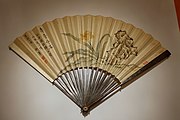
Folding fan painted aside the Qianlong emperor butterfly for Empress Dowager Chongqing, China, 1762 Advertising.
-

A portrait of a lady holding a rigid (oval) fan from the painting "Appreciating Plums", by Chinese artist Chen Hongshou
-
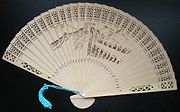
A typical commercially produced scented wood folding fan, featuring a lottery of the Great Wall of China
-

Taiwanese foldable fans are also used in the performance of Kung Fu
Japanese hand fan [edit out]
In ancient Japan, hand fans, such as oval and silk fans, were influenced greatly by Chinese fans.[10] The soonest visual depiction of fans in Japan dates back to the 6th century AD, with burial tomb paintings showed drawings of fans. The folding fan was invented in Japan,[11] with dates ranging from the 6th to 9th centuries.[12] [13] [14] [15] It was a court fan called the akomeogi (衵扇) afterward the Court women's full-dress named akome.[12] [16] Accordant to the Song Sui (History of Song), a Japanese monk Chōnen (ja:ちょう然/奝然, 938-1016) offered the folding fans (20 wooden-bladed fans hiogi (桧扇) and two paper fans kawahori-ogi (蝙蝠扇) to the emperor moth of China in 988.[14] [15] [17]
Later o in the 11th one C, Korean envoys brought along Korean folding fans which were of Japanese origin equally gifts to Chinese court.[18] The popularity of folding fans was so much that sumptuary laws were passed during Heian historic period which out-of-bounds the decoration of both hiogi and paper folding fans.[17] [19]
-

Asian country foldable fan (sensu)
-

Japanese folding fan of late Heian period (12th centred)
The early fans in Japan were ready-made by ligature slim-waisted stripes of hinoki (or Japanese cypress) together with thread. The number of strips of woods differed according to the soul's rank. Afterward in the 16th century, European nation traders introduced it to the west and soon both men and women throughout the continent adopted it.[13] They are used now by Shinto priests in dignified costume and in the formal costume of the Japanese court (they can be seen used by the Emperor and Empress during enthronement and marriage) and are brightly painted with long tassels. Obovate Japanese paper fans are sometimes titled harisen.
Printed fan leaves and painted fans are cooked on a paper ground. The paper was in the first place handmade and displayed the characteristic watermarks. Machine-made paper fans, introduced in the 19th century, are drum sander, with an even texture. Even nowadays, geisha and maiko use of goods and services folding fans in their fan dances too.
Asian country fans are made of paper on a bamboo frame, usually with a design painted on them. In improver to foldable fans (ōgi),[20] the non-bending fans (uchiwa) are popular and commonplace.[21] The fan is mainly used for fanning oneself in hot brave. The uchiwa fan afterwards spread to past parts of Asia, including Burma, Thailand, Cambodia and Sri Lanka, and such fans are still used by Buddhist monks A "ceremonial fans".[22]
Fans were also in use in the military as a path of sending signals on the field of battle. Notwithstandin, fans were principally used for social and solicit activities. In Japanese Archipelago, fans were variously victimised by warriors equally a form of artillery, by actors and dancers for performances, and by children as a toy.
Traditionally, the fixed fan (also called fixed fan) was the almost popular form in China,[23] although the folding fan came into popularity during the Ming dynasty Dynasty between the years of 1368 and 1644, and in that location are many beautiful examples of these folding fans still remaining.[24]
The mai ogi (operating theater Nipponese dancing lover) has ten sticks and a creamy paper mount showing the family peak, and Japanese painters made a large potpourri of designs and patterns. The slats, of ivory, bone, mica, mother of pearl, sandalwood, or tortoise trounce, were incised and crusty with report or framework. Collapsible fans have "montures" which are the sticks and guards, and the leaves were normally painted by craftsmen. Social import was attached to the fan in the Immoderate East as well, and the management of the fan became a extremely regarded feminine art. Fans were even used atomic number 3 a artillery - called the iron fan, or tessen in Nipponese.

A gunbai-uchiwa, the military leader's fan
Imag also, the gunbai, a military leader's lover (in old Japan); used in the modern mean solar day as an umpire's lover in sumo hand-to-hand struggle, it is a type of Japanese war fan, like the tessen.
Korea hand devotee [cut]
Every Dano (English hawthorn 5th of the lunar calendar) when the heat began, on that point was a custom in which the king distributed give fan to feudatory. Vassal, who received a hand goat god from the king, did an ink-and-wash painting and handed out white fans to his elders and the indebted people, which has made the practice of exchanging hand fan widely nonclassical. These cultural factors also contributed to the creation of various types of script fan in Korea.
Recent day [edit out]
Modern day hand fans are fewer popular than their ancestors but are still in use aside many.
Drag subculture [edit]
A large group that continues to use folding hand fans for cultural and fashion exercise are drag queens. Stemming from ideas of imitating and appropriating cultural ideas of excess, wealth, status and elegance, large folding hand fans, sometimes 12 inches (30 cm) or more in radius, are wont to punctuate speech, as part of performances, or A accessories to an outfit. Fans may have phrases embezzled from the vocabulary of drag and LGBTQ+ culture written on them, and may be decorated in other slipway, so much every bit the addition of sequins operating theater tassels.
Folding fans are oftentimes accustomed emphasize a point in a person's speech, rather than for express use of fanning ones self. A person mightiness harshly snap undetermined the fan when engaging in 'throwing tint' connected (comically disdainful) another individual, creating a loud snapping noise that punctuates the insult. Drag terpsichore numbers also utilise larger hand fans as a way of life to add flair and As a shor, used to underscore movements in the dance.
Popular drag comedy webshow UNHhhh has utilised folding fans as a point of sense of humour, with the intelligent made by a folding fan flowering coined onomatopoeically equally a "thworp" by the editors.
Categories [edit]
Hand fans take over ternion miscellaneous categories:
- Fixed (or rigid, monotonic) fans (Chinese: 平扇, píng shàn; Japanese: 団扇, uchiwa): circular fans, palm-leaf fans, straw fans, feather fans
- Folding fans (Chinese: 折扇, zhé shàn; Japanese: 扇子, sensu): silk folding fans, newspaper publisher folding fans, sandalwood fans
- Modern powered mechanical hand fans: hand fans which appear as mini mechanical rotating fans with blades. These are ordinarily axile fans, and often use blades made from a soft material for safety. These are usually battery operated, just can be hand cranked as well.
Gallery [edit out]
-

Nipponese collapsible fan, painted by Hokusai
-

-

Bengalese fans victimised in India
-

American fan from Index of American Design, National Gallery of Artistry.
-

Hand buff crafted from leather from southern Thailand
-

Very hoary cosmetic fan from Sri Lanka
-

Pamaypay or paypay, traditional heart-attribute hand fans from the Philippines woven from buri palm
-

A homemade hand fan made with theme.
See likewise [edit]
- Abaniko
Use in terpsichore [edit out]
- Buchaechum – Korean buff dance
- Cariñosa – national dance of the Philippines
- Singkil – traditional Maranao dance from the Republic of the Philippines
- Nippon būyo – traditional dance originating from Japan
Use as weapons [edit]
- Princess Iron Fan
- Asian nation war rooter
- Korean fighting fan
Use in comedy [edit]
- Harisen
Use in political relation [edit]
- Islami Andolan Bangla Desh – an Islamic party in People's Republic of Bangladesh that uses a hand winnow as its elective symbolic representation
Museums [delete]
- Musée de l'Éventail (Capital of France)
- The Fan Museum in Greenwich (Greenwich, London)
- The Hand Fan Museum in Healdsburg, California
References [edit]
- ^ "Online Exhibit - A Brief Account of the Hand Buff". web.ics.purdue.edu . Retrieved 2021-09-26 .
- ^ ῥιπίς, Patrick Henry George Liddell, Scott, A Greek-English Lexicon, on Perseus
- ^ Lazatin, Hannah (28 May 2022). "The Secret Messages Filipinas Used to Commit With Their Abanikos". Esquire . Retrieved 17 July 2022.
- ^ "Uncomely Fan Proposals - A Nice Gesture by Jeroen Arendsen". jeroenarendsen.nl. 19 June 2006.
- ^ FANA Journal, spring 2004, Fact & Fiction about the lyric of the fan by J.P. Ryan
- ^ "articles - brief account of fans". aboutdecorativestyle.com.
- ^ "Chinese Hand Fans". hand-fan.org.
- ^ Panati, Charles (2016). Panati's extraordinary origins of everyday things. ISBN978-0-7858-3437-3. OCLC 962329974.
- ^ Qian, Gonglin (2004). Formosan fans: artistry and esthetics. San Francisco: Long River Iron out. ISBN978-1-59265-020-0. OCLC 867778328.
- ^ "Japanese Hand Fans". hand-buff.org.
- ^ Nathan, Richard (17 April 2022). "The First Portable Device Loved by Japan's Literati". Red R-2 Authors . Retrieved 12 Jan 2022.
- ^ a b Halsey, William Darrach; Friedman, Emanuel (1983). Collier's encyclopedia: with bibliography and index. 9. Macmillan Acquisition Carbon monoxide gas. p. 556.
In the 7th century the folding sports fan evolved, the earlier imprint of which was a court fan called the "Akomeogi", which had xxx-eight blades connected by a rivet; IT had artificial flowers at the corners and twelve foresightful, pied silk streamers.
- ^ a b Lipinski, Edward R. (1999). The New York Times national repair almanac: a season-by-season take for maintaining your home . Lebhar-Milton Friedman Books. ISBN0-86730-759-5.
The Japanese improved the folding fan, the Akomeogi, during the sixth century. Portuguese traders introduced it to the west in the 16th century and soon both manpower and women throughout the continent adopted it.
- ^ a b Qian, Gonglin (2000). Chinese fans: art and esthetics. Long River Iron out. p. 12. ISBN1-59265-020-1.
The initial folding lover arrived as a testimonial that was brought to China by a Japanese monk in 988. Writings of both Japanese and Chinese scholars concerning the folding fan, which was believed to have been prototypical invented in Japan, plain suggest that it received its cast from the design of a clobber's fly.
- ^ a b Verschuer, Charlotte von (2006). Across the perilous shipboard: Japanese trade with Chinaware and Dae-Han-Min-Gook from the seventh to the sixteenth centuries. Cornell University. p. 72. ISBN1-933947-03-9.
Another Japanese origination enjoyed great success among foreigners: the collapsible fans. IT was invented in Japan in the eighth or ninth centred, when only round and fixed (uchiwa) fans made of palm tree leaves were known. -- their usage had spread end-to-end China in ancientness. Two types of collapsable fans developed: one was made of cypress-Sir Henry Joseph Wood blades bound by a thread (hiogi); the opposite had a frame with less blades which was covered in Japanese newspaper publisher and folded in a zigzag patterns (kawahori-ogi).
"The paper fan was represented by a thirteenth-C Chinese author, just well before that date Chōnen had offered twenty wooden-bladed fans and two paper fans to the Saturnia pavonia of People's Republic of China." - ^ 衵扇 [Akomeogi] (in Japanese). Mypedia.
- ^ a b Hutt, Julia; Alexander, Hélène (1992). Ōgi: a history of the Japanese fan. Dauphin Pub. p. 14. ISBN1-872357-08-3.
IT was recorded in the Song Shu, the official history of the Island Sung dynasty (960-1279), that in 988 a Japanese monk, Chonen, presented at motor lodge gifts of...
(Editor's note: Instead of Song Shu (宋書 Book of Song), Song Sui (宋史, History of Song) is correct.)
"There are also numerous references to folding fans in the keen classical literature of the Heian menses (794-1185), in particular the Genji Monogatari (The Tale of Genji) by Murasaki Shikibu and the Makura no more Sōshi (The Pillow Good Book) by Sei Shōnagon. Already by the end of tenth century, the popularity of folding fans was so much that restrictive Laws were promulgated during Chōho era (999-1003) which restricted the decoration of some hiogi and wallpaper foldaway fans." - ^ Tsang, Ka Bo (2002). Much than keeping cool: Chinese fans and fan painting. Royal Ontario Museum. p. 10. ISBN0-88854-439-1.
Guo Ruoxu, for example, has enclosed a short note about the folding fan in his Tuhua Jian Wen Zhi (Records of Paintings Seen and Heard Approximately, 1074) It states that Korean envoys often brought along Korean folding fans as gifts. They were, Guo also pointed out, of Nipponese stemma.
- ^ Medley, Margaret (1976). Chinese painting and the decorative way. University of London School of Eastern and African Studies, Percival David Foundation of Chinese Art. p. 106. ISBN0-7286-0028-5.
In origin it was evidently Japanese, common already in the Heian period of time. A fragment of a ripe Heian folding-rooter was excavated much decade ago at Takao-yama. Japanese fans were well known in China during the late ordinal hundred.
- ^ Nussbaum, Louis Frédéric et aliae. (2005). "Ōgi" in Japan Encyclopedia, p. 738., p. 738, at Google Books
- ^ Nussbaum, "Uchiwa," p. 1006., p. 1006, at Google Books
- ^ "Buddhist Monks Ceremonial Fans". Thebuddhasface.conscientious objector.uk. Archived from the primary along Apr 23, 2013. Retrieved 2017-10-27 .
- ^ "fan - decorative arts". Encyclopædia Britannica.
- ^ ChinesePod Weekly, Chinese Fans: More Than Keeping Cool down Archived 2012-11-13 at the Wayback Machine
Sources [edit]
- Nussbaum, Louis Frédéric and Käthe Roth. (2005). Japan Encyclopedia. Cambridge University: Harvard University Press. ISBN 978-0-674-01753-5; OCLC 48943301
Books [edit]
- Alexander, Helene. The Rooter Museum, Third Millennium Publishing, 2001 ISBN 0-9540319-1-1
- Alexander, Helene & Hovinga-Van Eijsden, Fransje. A Touch of Dutch - Fans from the Swayer House of Orange-Nassau, The Fan Museum, February 2008, ISBN 0-9540319-5-4
- Armstrong, Nancy. Quran of Fans. Smithmark Publication, 1984. ISBN 0-8317-0952-9
- Armstrong, Nancy. Fans, Keepsake Press, 1984 ISBN 0-285-62591-8
- Bennett, Anna G. Unfolding beauty: The art of the fan : the solicitation of Esther Oldham and the Museum of Fine Arts, Boston. Thames and Henry Hudson (1988). ISBN 0-87846-279-1
- Bennett, Anna G. & Berson, Pity Fans in fashion. Publisher Charles E. Tuttle Carbon monoxide gas. Iraqi National Congress &adenylic acid; The Beaux arts Museums of San Francisco (1981) ISBN 0-88401-037-6
- Biger, Pierre-Henri. Sess et sujets de l'éventail européen de Louis XIV à Louis-Philippe. Histoire of Art Thesis, Rennes 2 University, 2022. (https://tel.archives-ouvertes.fr/tel-01220297)
- Checcoli, Anna. " Prairie State ventaglio e i suoi segreti ", Tassinari, 2009
- Checcoli, Anna. " Ventagli Cinesi Giapponesi ed Orientali ", Tassinari, 2009
- Cowen, Pamela. A Fanfare for the Sunlight Mogul: Unfolding Fans for Louis XIV, Third Millennium Publishing (September, 2003) ISBN 1-903942-20-9
- Das, Justin. Pankha -Traditional crafted hand fans of the Indian Subcontinent from the collection of Justin Das - The fan museum, Greenwich (2004)
- Falkner, Rupert. Hiroshige Fan Prints, V&A publications, 2001 ISBN 1-85177-332-0
- Fendel, Cynthia. Novelty Hand Fans, Fashionable Operable Fun Accessories of the Ultimo. Hand Devotee Productions, 2006 ISBN 978-0-9708852-1-0
- Fendel, Artemis. Celluloid Reach Fans. Hand Fan Productions, 2001. ISBN 0-9708852-0-2
- Gitter, Kurt A. Japanese lover paintings from western collections. Publishing firm - New Orleans Museum of Art (1985). ISBN 0-89494-021-X
- Hart, Avril & Taylor, Emma. Fans (V & A Fashion Accessories Series). Publisher- V &adenylic acid; A Publications. ISBN 1-85177-213-8
- Hutt, Julia & Alexander, Helene. Ogi: A History of the Japanese Fan. Art Media Resources; Multilingual edition (February 1, 1992) ISBN 1-872357-08-3
- Irons, Neville Trick. Fans of Imperial Communist China. Kaiserreich Kunst Ltd, 1982 ISBN 0-907918-00-X
- Letourmy-Bordier, Georgina & Le Guen, Sylvain, L'éventail, matières d'excellence : La nature sublimée equivalence les mains de l'artisan, Musée de la Nacre et de Pelican State Tabletterie (September 2022) ISBN 978-2953110692
- City manager, Susan. A Collectors Guide to Fans, Charles I Letts, 1990
- Mayor, Susan. The Letts Channelize to Collecting Fans. Charles Letts, 1991 ISBN 1-85238-128-0
- North, Audrey. Australia's fan inheritance. Boolarong Publications (1985). ISBN 0-86439-001-7
- Qian, Gonglin. Chinese Fans: Prowess and Aesthetics (Arts of China, #2). Long River Press (Grand 31, 2004) ISBN 1-59265-020-1
- Rhead, G. Wooliscroft. The Account of the Sports fan, Kegan St. Paul, 1910
- Roberts, Jane. Unfolding Pictures: Fans in the Royal Collection. Publisher - Royal Collection (January 30, 2006. ISBN 1-902163-16-8
- Tam-o'-shanter, C.S. Fan Paintings past Tardily Ch'ing Shanghai Masters. Publisher - Urban Council for an exhibition in the Hong Kong Museum of Art (1977)
- Vannotti, Franco. Peinture Chinoise First State la Dynastie Ts'ing (1644–1912). Collections Baur, Geneve (1974)
External links [edit]
 Media side by side Hand fans at Wikimedia Commons
- A sense modality guide to Victorian fan voice communication, photos by Fabio and Gabrielle Arciniegas
- millimetre's fan collection with monographies on love symbols on fans, synthetic fans, George III Barbier and more
- Hand devotee collection Anna Checcoli
- Completely About Hand Fans with Cynthia Fendel
- Hand Fan Museum
- The Fan Band International
- Tessen warrior fan
- The Fan Museum in Greenwich, London
- Fan Association of North America
- Fans in the Staten Island Historical Company Online Collections Database
- La Invest de l'Eventail (French website dedicated to the European Manus Fan (most pages in English)
- Galerie Le Curieux, Paris
- Fans in the 16th and 17th Centuries
- Diverseness of Hand Held fans in variant colourise and styles
- Maison Sylvain Le Guen - contemporary hand fans by Sylvain Le Guen
- Allhandfans - Site entirely dedicated to the hand fan
- Museu Tèxtil i d'Indumentària in Barcelona
Where Can I Buy Folding Fans Near Me
Source: https://en.wikipedia.org/wiki/Hand_fan


0 Comments